01 / 11Flagship / Robotics & Control
Two-DOF SCARA Robot
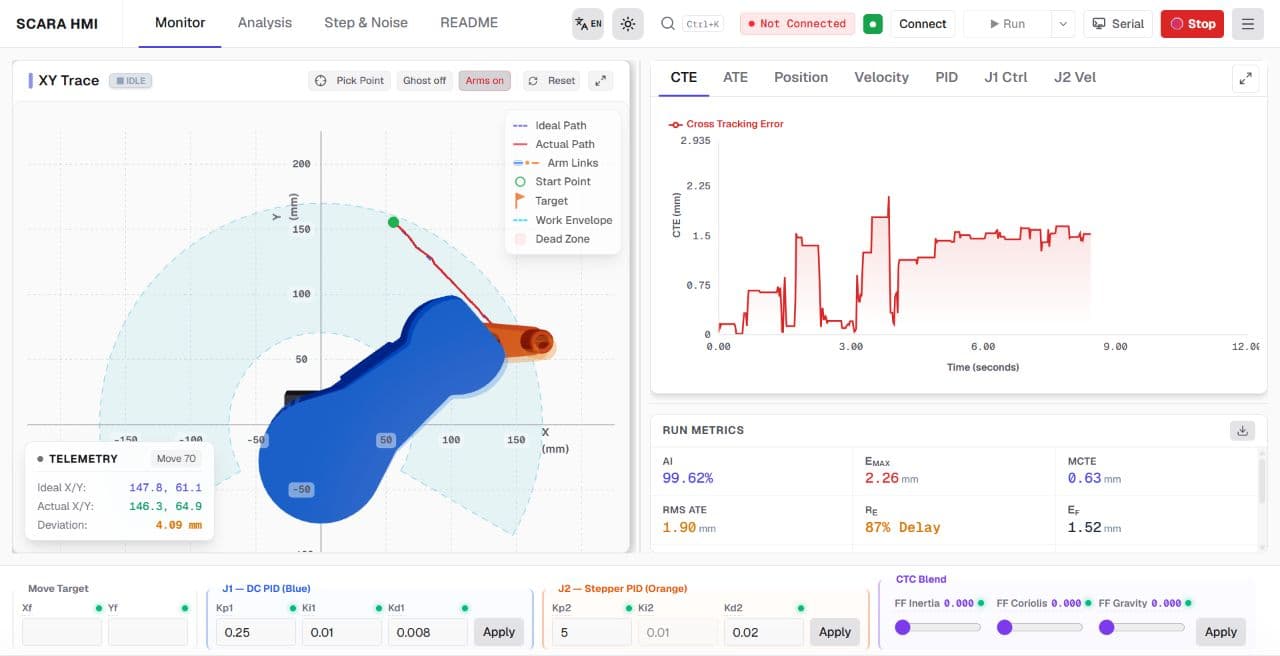
A planar teaching robot developed as one connected system: mechanical hardware, embedded control, telemetry, experiments, and a browser-based operator interface.
01Context
The engineering problem
Make a two-joint physical system understandable and testable across mechanics, actuation, motion control, sensing, and experimental analysis.
Built a shared telemetry contract between ESP32 firmware and a Next.js HMI, then tested a tracking differentiator, a trapezoidal motion profile, and independently switchable inertia, Coriolis, and gravity compensation.
The tracking differentiator reduced mean absolute tracking error by 38.7%, while the trapezoidal profile reduced end-effector RMSE by 50.4%. The same experiments also exposed model mismatch: inertia compensation increased contour error, while gravity compensation cut final uphill error from 97.77 mm to 8.45 mm.
02System architecture
How the layers connect
The diagram is paired with a text alternative and remains readable without animation or WebGL.
- Mechanism: Planar two-link SCARA hardware with DC and stepper actuation.
- Firmware: PID, tracking differentiator, trapezoidal trajectory, and selectable feedforward terms.
- Telemetry: A shared packet schema keeps firmware and HMI interpretations aligned.
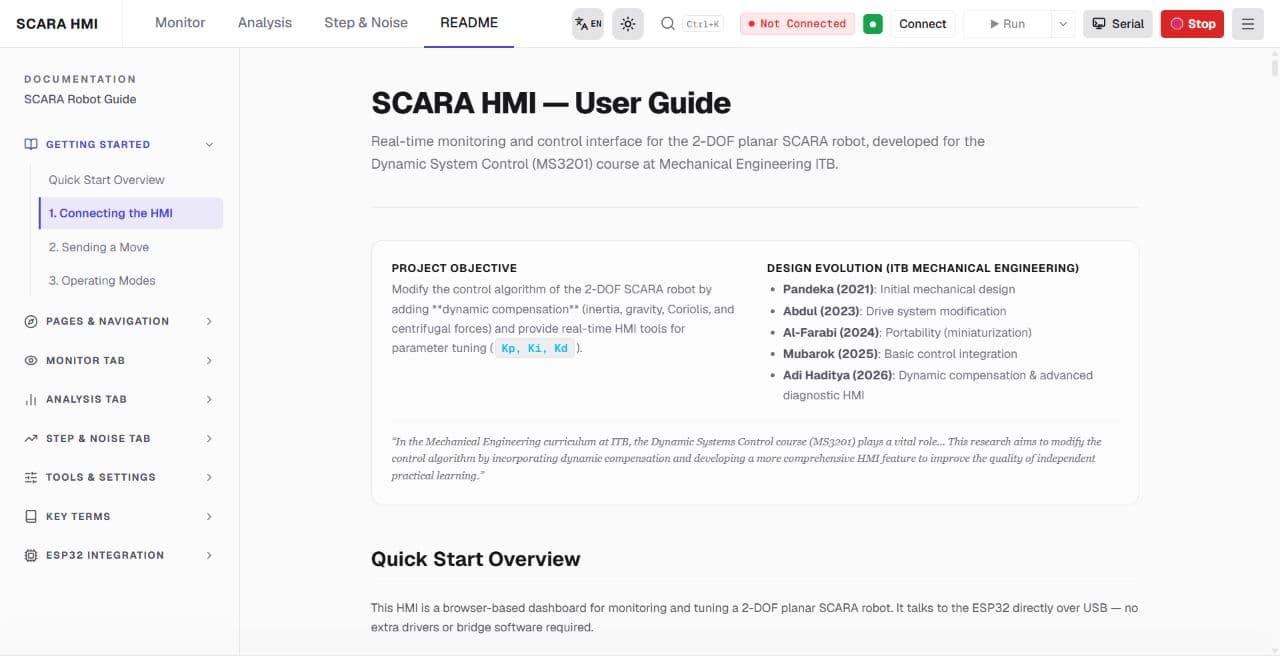
- HMI: Browser-based operation, visualization, capture, and experiment review.
- Analysis: Python export tooling produces selected CSV datasets for comparison.
03Engineering decisions
Choices that shaped the result
Separate the compensation terms
Inertia, Coriolis, and gravity compensation are independently switchable so experiments can make causal comparisons rather than treating feedforward as one opaque feature.
Share the telemetry definition
Firmware and web code are generated around one packet definition, reducing silent drift between embedded output and interface parsing.
Treat data capture as part of the product
Experiment records and export scripts live beside the operating software, making validation a first-class system layer.
Report the result, not the expected story
Inertia compensation increased mean contour error by 95.7% under the tested model. Keeping that negative result visible made model mismatch an engineering finding instead of hiding it behind aggregate performance claims.
04Product evidence
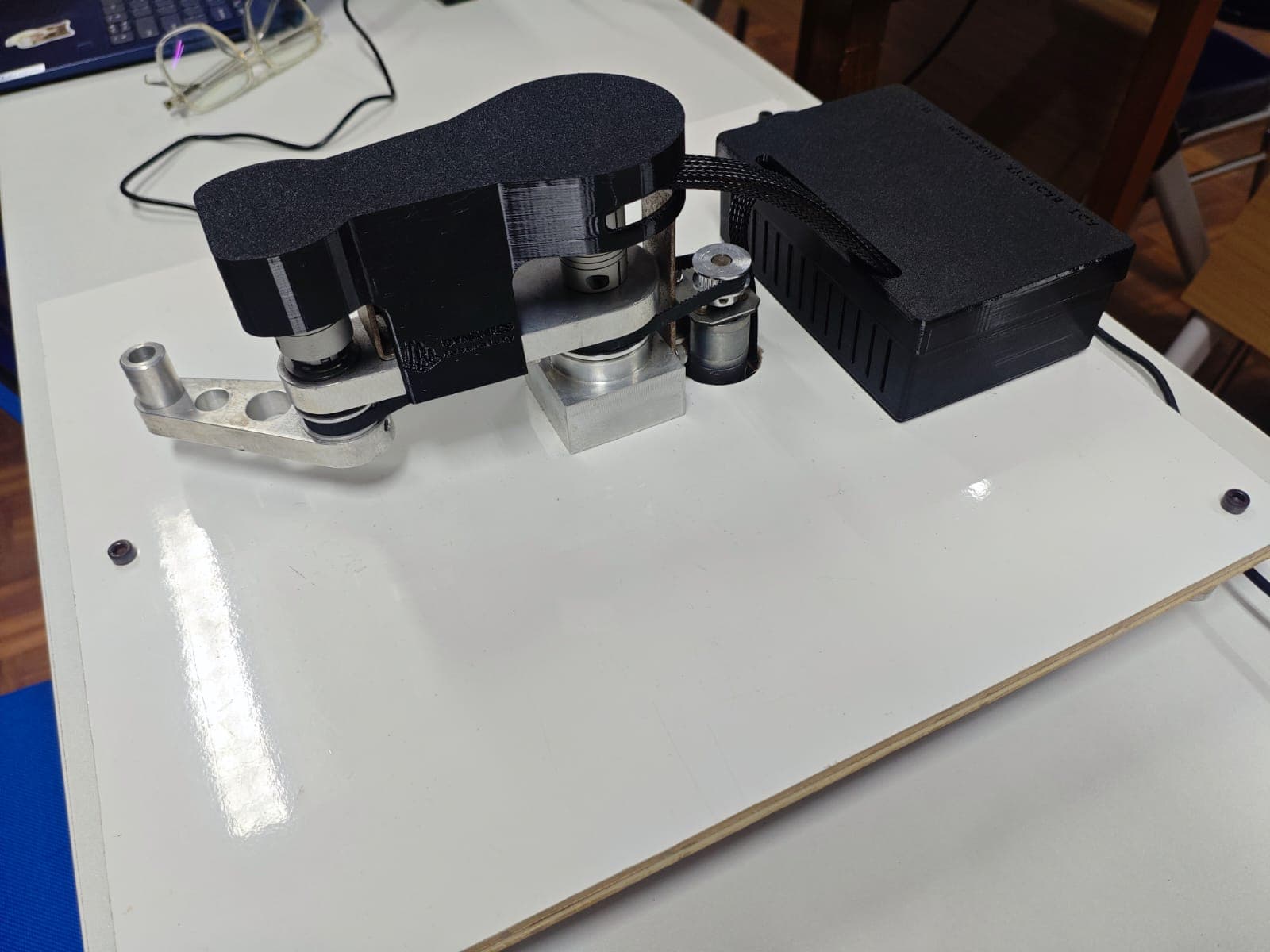
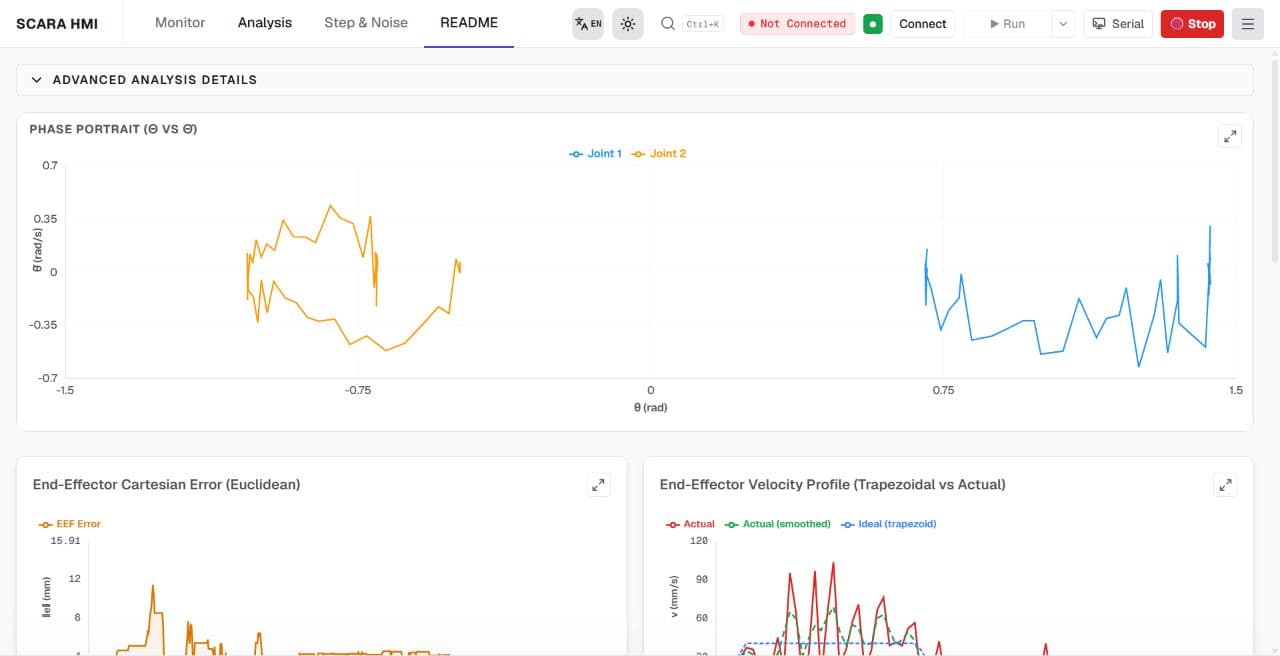
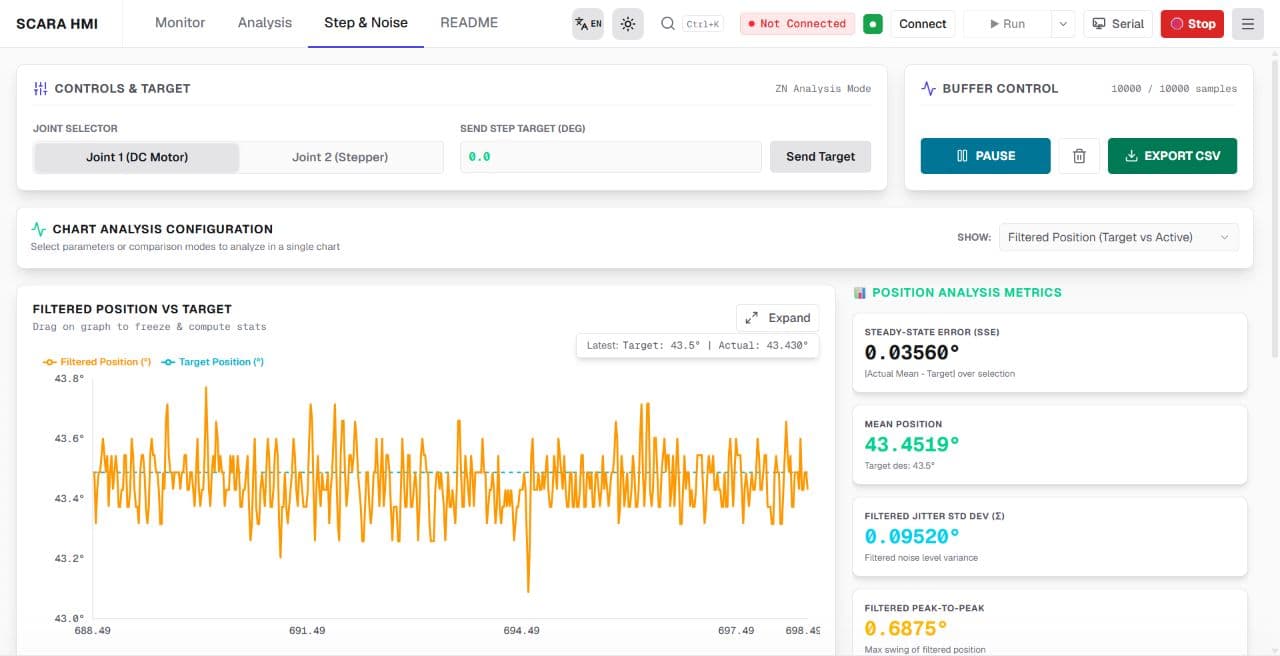
Selected interface views
Captured from the deployed product. Authenticated screens are shown only in privacy-safe states.
05System in motion
Selected demonstrations
Short, recruiter-friendly clips. Playback is manual and videos load metadata only until opened.
06Technical footprint
Stack in context
- ESP32
- C++
- Next.js
- TypeScript
- Python
- Web Serial
- 38.7% lower tracking error with TD
- 50.4% lower RMSE with trapezoidal motion
- Five controlled experiment groups